Executive Summary
Peak seasons bring both opportunity and chaos - retail booms, service surges, financial closings, and endless deadlines. Yet for employees, these periods often mean long hours, mounting pressure, and emotional fatigue.
But AI is changing the story. Far from replacing workers, AI acts as a productivity amplifier and stress buffer. It helps employees focus on meaningful work instead of repetitive tasks, forecast workloads, and improve decision-making in real time.
The results are eye-opening:
- In industries most exposed to AI, revenue per employee has risen by nearly 27%, compared with about 9% in less AI-exposed sectors, according to a PwC Global AI Jobs Barometer 2024 report. (US AI Jobs Barometer: PwC_)
- Workers with AI skills now command a 56% wage premium in many markets - a sign that businesses value the productivity and innovation these employees bring.
- A separate study by Microsoft and LinkedIn (2024 Work Trend Index) found that employees could save an average of 122 hours per year by offloading repetitive administrative tasks to AI tools.
In essence: AI isn't just a tech trend. It's a workplace ally that helps employees not just survive peak seasons-but thrive in them.
Let's see the glimpse below,
- Introduction: The Peak Season Pressure
- The High Cost of Peak Season Stress
- AI as the Game-Changer
- Employee Experience: From Overload to Empowerment
- The Adoption Gap: Leaders vs. Employees
- Smarter Planning with AI During Peak Seasons
- Employee Well-Being and AI: Finding Balance
- Building a Peak-Ready Workforce: Best Practices
- The Future Outlook: AI as an Enabler of Sustainable Performance
- Conclusion: Thriving, Not Just Surviving, with AI
Introduction: The Peak Season Pressure
Every industry faces its own “crunch time.” Retailers gear up for holiday sales. Finance teams rush toward quarterly closes. Support centers brace for a flood of customer requests.
According to Zendesk Retail Gazette, 2024 report, in 2023's retail peak season alone, sales climbed 3.8% year-over-year to hit a record £725.95 billion. Yet with higher stakes comes higher strain. 52% of customers said they would switch brands after just one bad experience, and 49% abandoned once-loyal brands due to poor service.
The human cost is clear: burnout, stress, and declining work quality. Employees often feel stretched thin during these high-intensity periods. But imagine if AI could shift the narrative - from “survive the rush” to “thrive in the rush.”
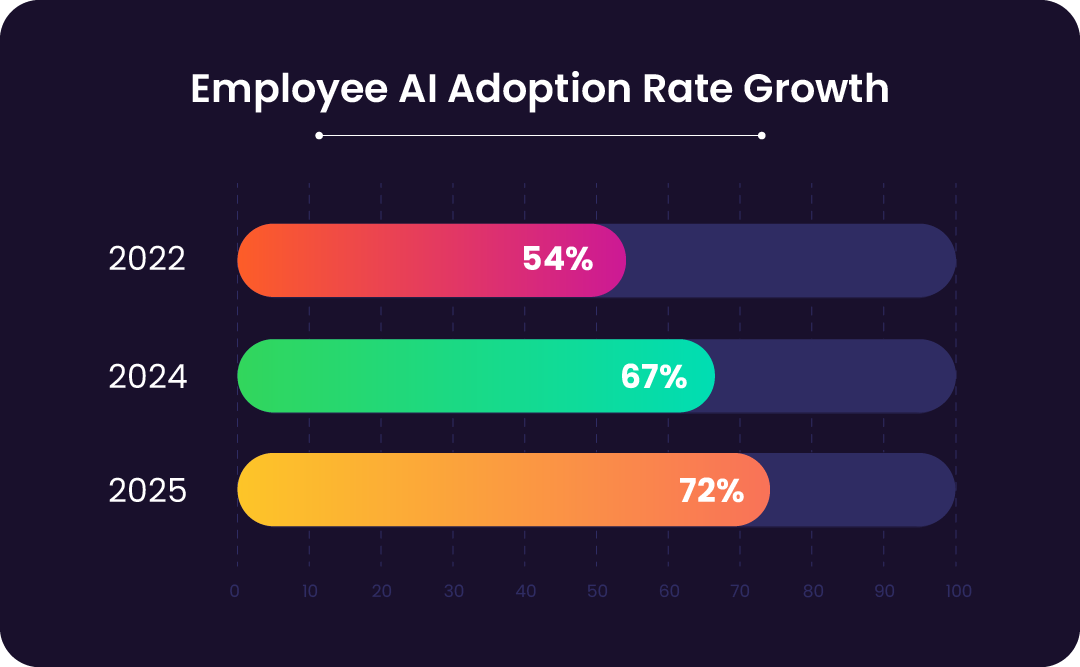
And employees are catching on. Reports show that AI adoption among workers is on a steady rise-54% in 2022, 67% in 2024, and projected to hit 72% in 2025, according to the KPMG Global AI Adoption Study 2024.
The High Cost of Peak Season Stress
Stress might feel like “part of the job,” but it’s far more expensive than most leaders realize.
According to the American Psychological Association (APA), stress-related absenteeism and burnout cost U.S. businesses over $300 billion per year in lost productivity, healthcare, and turnover. And the worst of it hits during those make-or-break seasons.
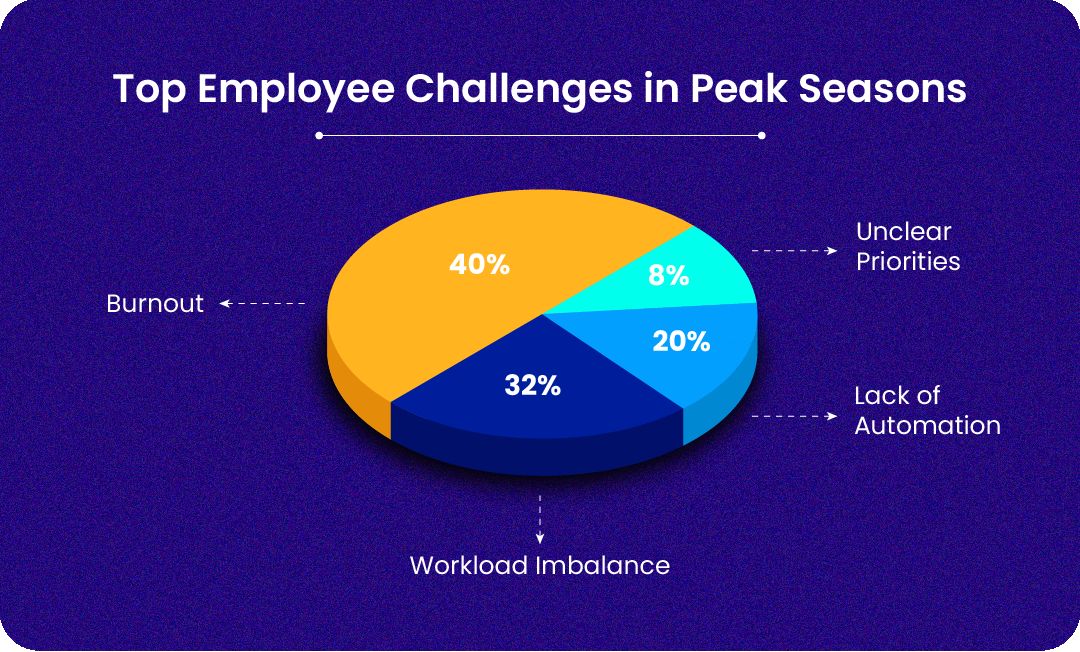
In fact, 40% of employees report feeling burned out during peak business months. Another 32% cite workload imbalance, 20% blame for a lack of automation, and 8% say unclear priorities create confusion.
Let's break it down:
- Customer service agents feel the pressure of handling thousands of tickets with tight deadlines.
- Finance teams stay up late reconciling spreadsheets before quarterly closing.
- Retail employees manage both digital and physical chaos during sales peaks.
The emotional toll? Fatigue, disengagement, and frustration. Stressed employees are 63% more likely to take unscheduled leave and 50% less likely to feel engaged at work (APA, 2023).
And this isn't just a “people” issue - it's a business one. Burned-out employees deliver slower, lower-quality work and are twice as likely to look for another job.
AI as the Game-Changer
AI isn't a futuristic luxury - it's today's stress relief strategy.
When done right, AI doesn't just automate-it amplifies. It helps employees work smarter, not harder. From predictive scheduling to automated communication, AI ensures that no one spends hours doing what technology can do in minutes.
The impact is measurable:
- Employees using AI tools save an average of 122 hours per year on admin tasks – Microsoft Work Trend Index, 2024.
- Businesses that leverage AI-driven workflows see 40% higher productivity – Zendesk Retail Gazette, 2024.
- AI-heavy sectors enjoy 27% faster revenue growth per employee – PWC Global AI Jobs Barometer, 2025.
And it's not just about numbers - it's about energy. When AI handles repetitive work, employees regain the time and mental bandwidth to focus on meaningful tasks.
From automation to predictive intelligence, AI's role has evolved into four stages:
| Work Mode | Description |
|---|---|
| Manual | Employees handle everything themselves |
| Assisted | AI supports with task automation |
| Predictive | AI forecasts demand and workload trends |
| Autonomous | AI makes real-time operational adjustments |
Employee Experience: From Overload to Empowerment
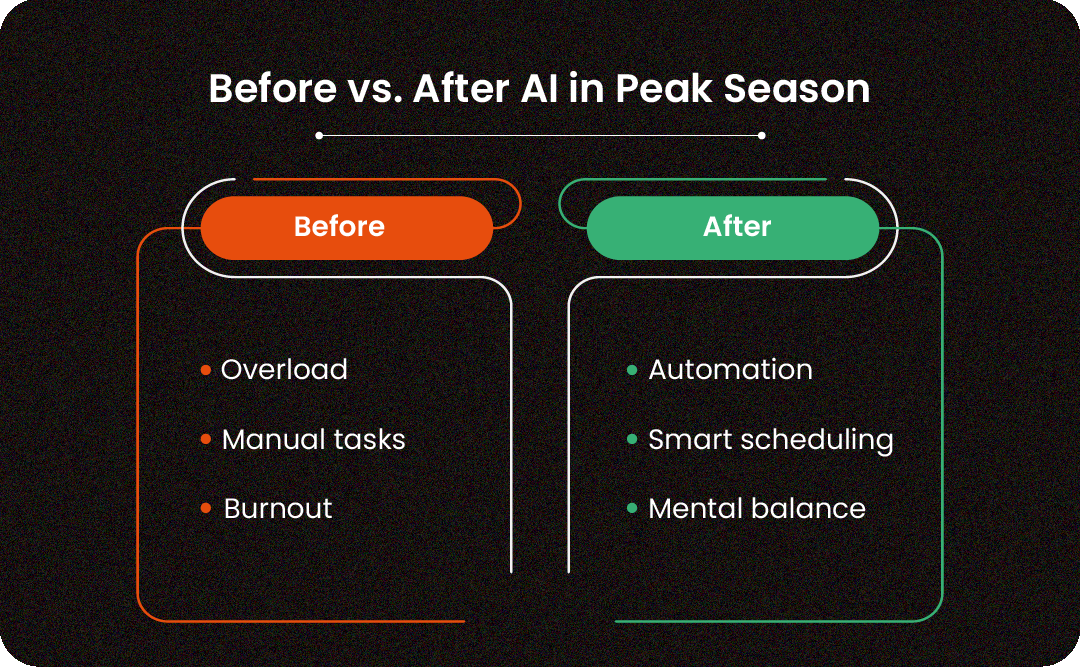
AI doesn’t just automate - it alleviates. It helps distribute workloads, predict bottlenecks, and create a sense of control.
Real-world examples show this shift:
- At Charlotte Tilbury, AI-powered automation deflected 40% of customer contacts, allowing support advisors to focus on complex, empathy-driven tasks – Zendesk, 2024.
- Gallup found that AI usage among employees nearly doubled from 21% to 40% in just two years.
The result? Less burnout, higher engagement, and more creative energy.
The Adoption Gap: Leaders vs. Employees
Here's the paradox: while leadership teams are all in on AI, most employees still aren't using it.
According to Business Insider (2024), 87% of executives use AI tools regularly to support decision-making, but only 27% of employees feel comfortable doing the same. It's not that employees don't see the value - it's that many don't feel equipped or supported to use it effectively.
That's the real “AI confidence gap.”
Some of it comes down to fear - the idea that AI might replace jobs rather than enhance them. Others simply lack hands-on training or clear guidance on how AI fits into their daily workflow. As a result, many teams are stuck in a holding pattern - watching innovation happen from the sidelines.
The Boston Consulting Group (BCG) AI Adoption 2024 Report paints a broader picture:
- Only 26% of companies have developed the capabilities to move beyond experimentation and actually scale AI value.
- Just 4% are considered “cutting-edge” - consistently generating measurable ROI from AI.
- Meanwhile, a striking 74% still struggle to turn AI investments into tangible business results.
The good news? The payoff for getting it right is huge. BCG found that AI leaders enjoy 1.5x higher revenue growth, 1.6x greater shareholder returns, and 1.4x higher returns on invested capital than their peers. (AI leaders in India see 1.5x revenue growth, only 26% are fully mature: BCG Report, ETCFO)
Those aren't just financial wins - they represent stronger operations, smarter decisions, and, most importantly, happier employees. When AI is truly embedded across departments, it removes bottlenecks, distributes workloads more evenly, and empowers teams to perform without burnout.
Bridging this gap means putting people first:
- Offer accessible AI training - make learning part of the culture.
- Communicate clearly how AI supports, not replaces, human roles.
- Choose intuitive, no-code AI tools that let employees feel in control.
When workers understand that AI isn’t the enemy but the assistant they've always wanted, adoption skyrockets - and so does performance.
Smarter Planning with AI During Peak Seasons
When the pressure's on, the difference between thriving and scrambling often comes down to one thing - planning. And that's exactly where AI excels.
AI gives teams the ability to plan ahead instead of playing catch-up. It anticipates demand, helps distribute workloads efficiently, and prevents the kind of last-minute chaos that drains employees during peak times.
Take retail, for example. The Zendesk Retail Gazette 2024 report revealed that brands using AI for support forecasting improved response times by 40%, even during the busiest shopping weeks. Similarly, Thomson Reuters (2024) found that AI is projected to save employees 12 hours per week by 2029, with at least 4 hours saved weekly within the next year, thanks to smarter scheduling and real-time performance tracking.
So, how does AI make this level of efficiency possible? Let’s break down the process - step by step:
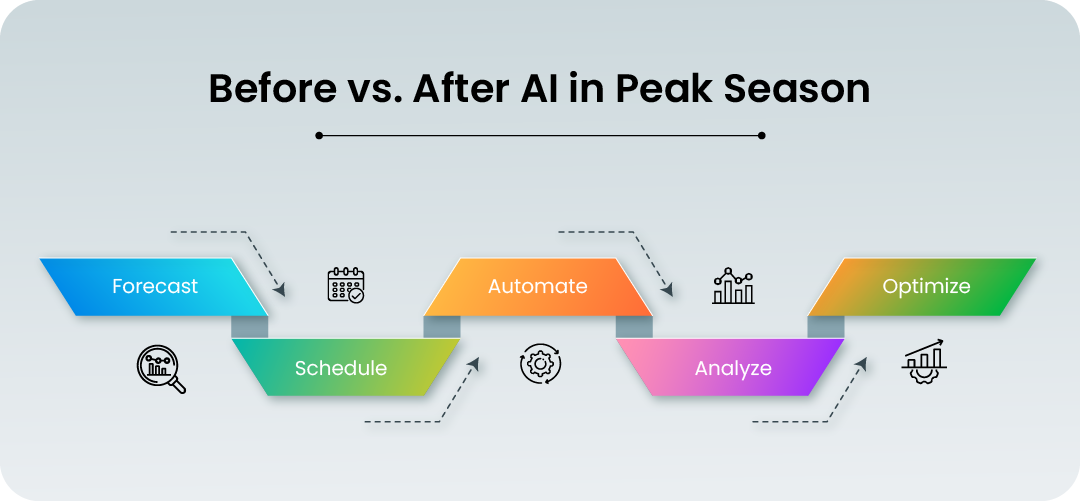
Forecast
AI begins by analyzing historical data - sales patterns, customer inquiries, seasonal demand spikes, and employee workloads. It forecasts upcoming surges, helping managers anticipate pressure points before they appear. Imagine knowing which week your team's workload will double and preparing for its weeks in advance.
Schedule
Once forecasts are in place, AI assists in building smarter schedules. It balances employee availability, skill levels, and projected workloads - ensuring that no one is overbooked or underutilized. It's like having a digital operations manager who knows exactly how to staff for success.
Automate
Next comes automation. Tools like Yoroflow handle repetitive workflow tasks - from approval to routing to task assignments - so managers can focus on strategy, not spreadsheets. This means fewer late nights spent juggling to-do lists, and more time spent guiding teams.
Analyze
AI continuously tracks real-time data to measure performance. It identifies delays, workload imbalances, and communication bottlenecks instantly. With this visibility, managers can make fast, informed decisions before small issues become major blockers.
Optimize
Finally, AI learns from every cycle - recommending improvements for the next season. It might suggest adjusting staffing levels, refining workflows, or introducing new automation triggers. The more data it processes, the smarter and more efficient it gets.
In essence, AI transforms reactive management into proactive leadership. It's not about doing more work - it's about doing it smarter, smoother, and with less stress.
Employee Well-Being and AI: Finding Balance
Let's be honest - no amount of caffeine can make up for burnout.
During peak seasons, when workloads skyrocket and deadlines tighten, employee well-being often takes a back seat. People stretch themselves thin, skip breaks, and push past limits to keep up with demand. But here's the truth: productivity doesn't have to come at the cost of peace of mind.
AI is quietly becoming one of the most effective well-being tools in the modern workplace - not by working harder, but by helping humans work healthier.
According to PwC's Workforce Survey 2024, 51% of employees say AI improves productivity without increasing stress. And the Zendesk Retail Gazette 2024 report found that teams using AI-powered customer service tools handled spikes in demand 40% faster - while reporting fewer stress-related complaints from staff.
That's the power of intelligent balance.
AI can act as a built-in well-being assistant. It helps employees stay on track and take care of themselves:
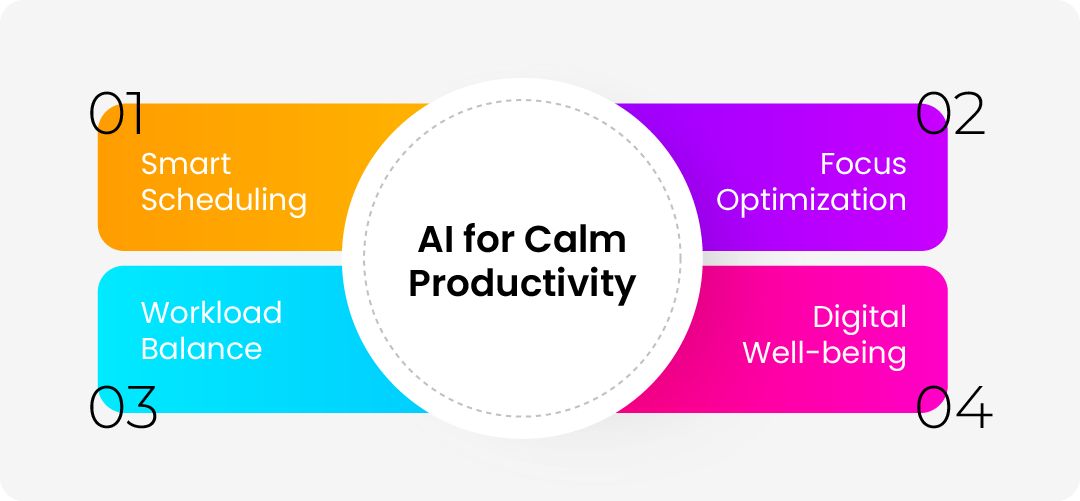
- Smart scheduling: AI analyzes workload data and ensures shifts or tasks are distributed fairly - no one gets overwhelmed.
- Automated reminders: From “take a short break” nudges to “wrap up for the day” alerts, AI tools can encourage healthy boundaries.
- Digital decluttering: Platforms like YoroConnect centralize communication - combining chats, emails, and calls - so employees don't have to switch between five apps to get work done.
- Focus optimization: AI can highlight the top three priorities for the day, minimizing cognitive overload and decision fatigue.
Used ethically, AI doesn't invade personal space or track productivity for punishment - it supports balance. It allows teams to perform at their best without feeling like they're constantly on edge.
Because when employees have breathing room, creativity thrives, collaboration improves, and performance becomes sustainable - not stressful.
Building a Peak-Ready Workforce: Best Practices
Thriving in peak seasons isn't just about automation - it's about alignment. The best-performing teams combine AI-driven processes with human creativity and empathy.
Here's how Yoroflow's AI-powered suite empowers that balance:
- Yoroflow: Automates workflows across HR, finance, and operations. No more chasing manual approvals or lost forms.
- YoroProject: Predicts project risks and keeps deadlines realistic.
- YoroCRM: Streamlines lead management and customer follow-ups during busy sales cycles.
- YoroDesk: Handles ticket prioritization and auto-responses, reducing agent stress.
- YoroConnect: Keeps communication consistent across multiple platforms.
- YoroDocs & YoroForms: Simplify documentation and form automation.
- YoroAI: Acts as a true digital assistant - analyzing data and offering actionable insights from uploaded documents or URLs.
Together, these tools embody how AI can humanize productivity - making teams smarter, not just faster.
The Future Outlook: AI as an Enabler of Sustainable Performance
AI isn't just a short-term productivity hack - it's becoming the foundation for a more balanced, sustainable way of working.
The organizations that will thrive tomorrow are those that redefine success today - not just in terms of profits or output, but in the health, engagement, and creativity of their people. Automation is freeing employees from repetitive tasks, giving them space to think, collaborate, and innovate. And that shift is shaping the next evolution of work - one built on human-AI synergy.
According to the Boston Consulting Group (2024), companies that lead in AI maturity see 1.5x higher revenue growth, 1.6x greater shareholder returns, and 1.4x better returns on invested capital than their peers. But what's often overlooked is why: these organizations don't just use AI to do more - they use it to work smarter and create healthier workplaces.
Imagine a future where employees spend less time on low-impact work and more time solving meaningful problems. Where AI tools handle scheduling and data, people focus on creativity, connection, and decision-making. That's not a distant dream - it's already happening in forward-thinking companies across industries.
And as AI technology evolves, so will our ability to predict stress patterns, personalize workload management, and design more inclusive, resilient teams. The workplace tomorrow won't be defined by speed alone, but by balance - where empathy meets efficiency, and innovation doesn't come at the cost of well-being.
In short, sustainable performance isn't about working harder - it's about creating systems that let people and technology thrive together.
Conclusion: Thriving, Not Just Surviving, with AI
Peak seasons will always test the limits of performance - but with the right technology, they don't have to test the limits of people.
AI is reshaping how organizations think about productivity, efficiency, and well-being. It's no longer about doing more in less time; it's about doing the right work - smarter, faster, and with greater balance. From predictive scheduling and automated workflows to intelligent assistance and seamless communication, AI has proven it can turn high-pressure periods into opportunities for innovation and growth.
Solutions like Yoroflow, YoroDesk, YoroAI, and YoroConnect show how automation and intelligence can come together to empower teams. When routine tasks are handled automatically, employees can focus on creativity, strategy, and building meaningful connections - the things machines can't replicate.
As we look ahead, success won't be defined by how fast teams work, but by how sustainably they perform. Businesses that invest in AI not just as a tool, but as a partner, will build workplaces that are not only more productive - but also more human.
Because when employees thrive, businesses don't just survive peak seasons - they shine through them.